What Our GenAI Dependency Means for Critical Thinking and Creativity
Our reliance on GenAI is reshaping critical thinking and creativity, and how we define humanity will matter more than ever before.


Until quite recently, if you asked a person whether they view machines as intelligent or smart, their response would likely be no. Home assistant robots, cleaning robots, and voice assistants were frequently marketed as having “intelligent” features, yet their limited and predictable responses quickly revealed an obvious gap between shiny promises and reality. “Intelligence,” before the stage of Generative AI, seemed to only imply that the robot can respond to inputs in ways that seem functional or adaptive to different circumstances. Almost no average consumer of technologies could have imagined that there would exist a technology that can learn, communicate, process, and create information in our language on its own, yet with the unexpected release of ChatGPT, what seemed would only happen in a sci-fi movie or our dreams has been turned into reality.
ChatGPT (or technically, its underlying GPT models, also known as the Generative Pre-training Transformer models), along with other models that were trained on a large amount of human language and can process and generate information in natural language (any human language that has developed naturally, in contrast to computer code), are known as Large Language Models or “LLMs” in short. People also refer to LLMs as Generative AI or GenAI due to their abilities in creating a vast amount of texts, and although the phrase would also include AIs that generate images or videos, these terms are often interchangeably used. According to Zhao et al., language models, in general, were originally designed to predict the next word in a sentence, aiding in tasks like speech recognition and machine translation. LLMs emerged from a series of advancements beginning from 2017, when researchers at Google introduced the transformer architecture in the paper Attention Is All You Need (Vaswani et al.). At their essence, all language models, work by assigning mathematical probabilities, also known as “weights,” to word sequences, allowing them to predict what logically comes after a sentence (Zhao et al.)—but in order to make this prediction “legible” and “human,” they have to be trained on a massive amount of data, which was made possible due to the new transformer architecture design. On November 30, 2022, OpenAI released ChatGPT, in which “GPT” stands for Generative Pre-training Transformer, an interface providing easy access to the underlying models for all users (OpenAI). Within just five days of its launch, one million users signed up, as people rushed to chat with a robot that spoke in a way so humane that it was sometimes hard to distinguish from a human and knew nearly everything—capabilities being described as “impressive—and sometimes scary” (Smalley). As the journal The Conversation puts, ChatGPT “not only learns from vast amounts of data but also produces things—convincingly written documents, engaging conversation, photorealistic images” (Smalley).
Today, the utilization of LLMs and GenAI has expanded across diverse sectors, and people are rapidly adapting them: they allow people to learn, plan, process, and produce information with unprecedented speed. Students, educators, and professionals alike use these systems to streamline research, generate ideas, and even write entire programs. The New York Times reported that “ChatGPT can craft jokes and working computer code, guess at medical diagnoses, and create text-based games” (Chen). Moreover, statistics show that more than a third of Generation Z and nearly one-third of Millennials have embraced generative AI in their daily routines (Drenik). With LLMs like GPT, traditional methods of learning and working that involve more manual labor have become unfashionable as people value powerful, rapid, automated, personalized assistances at their fingertip.
However, as reliance on AI grows, the general population has started to experience a sense of “existential crisis.” A particular focus point of discussions is critical thinking and creativity. Some doubt the purpose of thinking in the age of AI—“Why think at all, when the computer can do that for you?” (Lopatto)—as OpenAI’s o1 model and DeepSeek R1 gain capabilities to plan their thoughts and perform reasoning processes just like humans before they respond. Some worry that as they “rely too much on these tools,” they would “lose the capacity for critical and creative thought,” because they might not be challenged to improve their writing and thinking skills when they instead use LLM to generate materials for them (Chen). And in schools, the response to LLM tools is mixed: Some rejects the technology altogether in fear of harming students’ critical thinking and creativity, while others acknowledge the necessity to incorporate new tools: “If these students are never taught about, and never learn how to operate ChatGPT in their schools, they will be unprepared for their life ahead” (Chen). By integrating AI tools and becoming increasingly dependent on them in our lives, are we losing and giving our critical thinking and creativity abilities away to LLMs?
Adrienne LaFrance’s essay “In Defense of Humanity” acknowledges how with the latest advancements in generative AI, computer programs now produce “sophisticated, original text, audio, and video,” but at the same time, “hallucinate, manipulate, and fabricate” (19). Her comparison of GenAI as “a mercurial prophet”—a teacher subjected to sudden or unpredictable changes of mind—to Google as “the modern-day Library of Alexandria” (one of the most significant libraries of the ancient times) illustrates how our reliance on these technologies can make us vulnerable due to us placing blind trust in GenAI’s seemingly endless knowledge despite its inherent unreliability. She acknowledges AI’s potential for humans to “outsource busywork” and regain valuable time for more meaningful matters (19). Yet, she also warns that as AI technology becomes more integrated into our daily lives, AI may “erode our understanding of what is real” and turn genuine connections into “illusional” data points (19). LaFrance is suggesting that AI’s seeming authenticity might lead us to blur the boundary between artificial interactions and genuine human relationships. In addition, if humans do not resist against this trend, LaFrance says that we might be entering a new era where profit-driven corporations use personal data “not just to splinter our shared sense of reality, but to invent synthetic replicas,” of our wisdom, thinking, and creativity, that threaten and replace their very own artificial origins—“artists, writers, and musicians” and average people (20).
LaFrance seems to send a message to us that GenAI poses a huge threat to people whose work or missions rely most on critical thinking and creativity. And her fear of AI “synthetic replicas” is not unbased. When NovelAI’s generative AI service, trained on digital artworks, debuted on October 3, 2022, it caused major outrage regarding unconsented copyright use and the economic threats to human artists; in a related pushback, artists have posted anti-AI slogans on major media sites and are now actively slipping anti-AI “poison” into published works to combat model training (Leffer). The trend that AIs’ practical values making them the seemingly largest threats to human workers across numerous domains doesn’t stop here. On December 05, 2024, an advertisement for the AI company Artisan, posted on 2nd Street in San Francisco, was posted onto the Internet and gained wide attention (Edwards). The billboard depicts the startup’s LLM agents, Artisans, who “won’t complain about work-life balance.” The company’s other billboards also read “stop hiring humans.” Beside the billboard in the image sits a homeless man. With its stark contrast of human vulnerability against the unsurpassable efficiency of autonomous agents, the image encapsulates a growing unease about LLMs’ impacts on us.
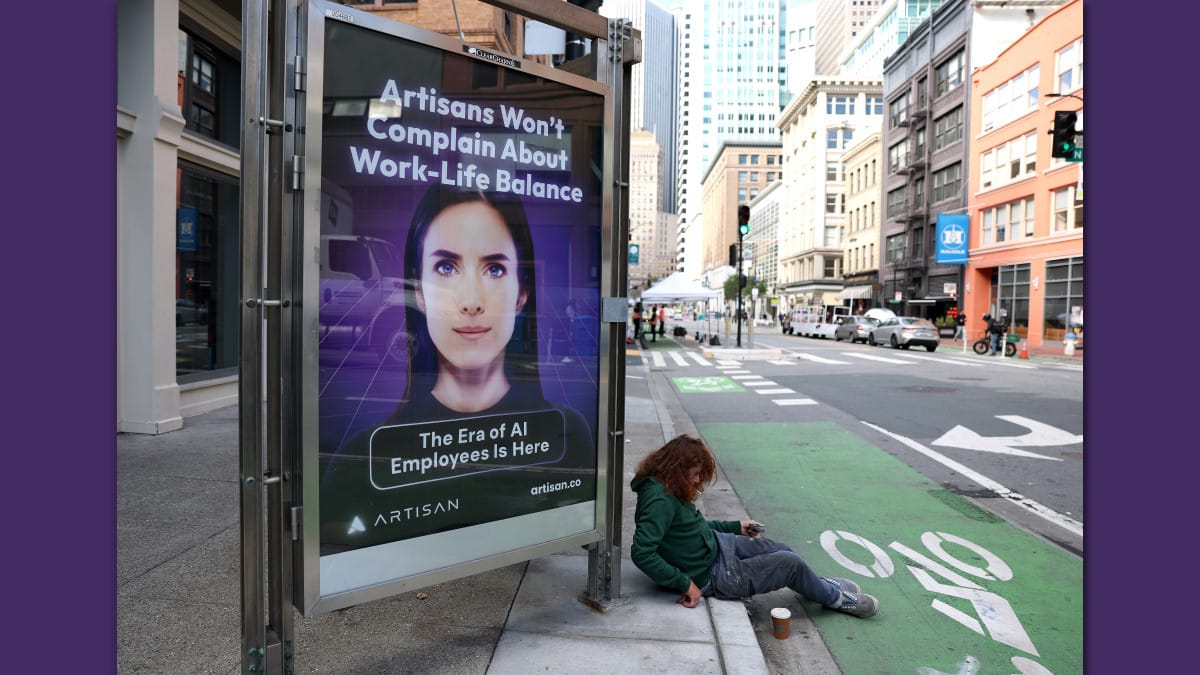
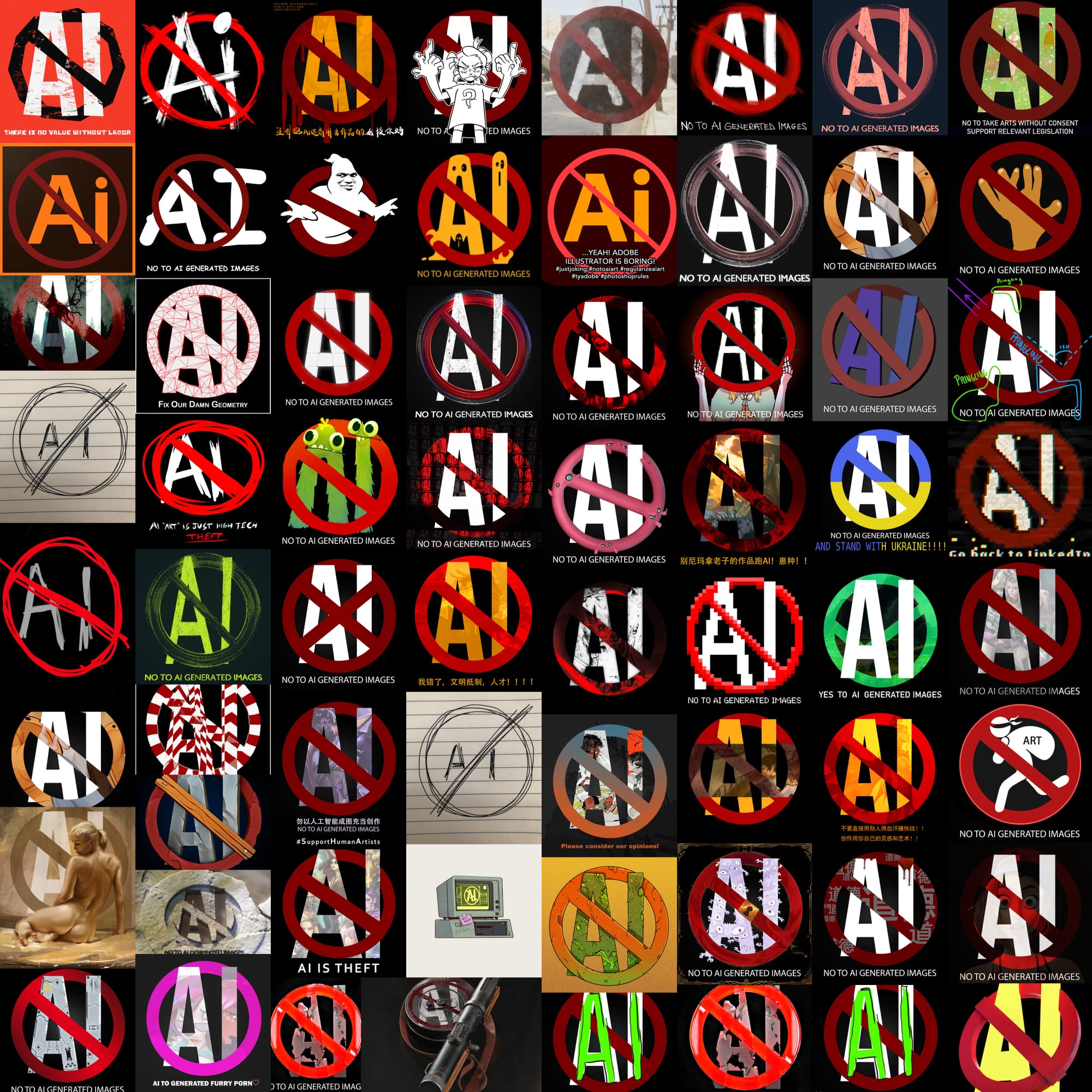
Left: An advertisement for the AI company Artisan is posted on 2nd Street on December 05, 2024, in San Francisco. (Source: Justin Sullivan via Getty Images) Right: A collage of various anti-AI-generated images protest symbols, featuring the letters “AI” crossed out with red slashes, often enclosed within a prohibition sign. Many of the symbols include phrases such as “NO TO AI GENERATED IMAGES” and “AI IS THEFT.” These symbols were posted on various content sharing platforms.
But after all, I doubted, LLMs might just be another point in human history where we sacrifice some of ourselves to advance efficiency and convenience, much like when the computers replaced human calculators and when looms replaced tailors. For instance, workers who performed complex calculations lost their roles as digital computers proved to be faster and more reliable. Similarly, the introduction of mechanical looms during the Industrial Revolution drastically improved the scale and affordability of cloth production, yet this efficiency came at the cost of traditional tailors, whose skilled labor that we once deemed central to craftsmanship, became obsolete. In each case, progress has favored automation and efficiency over our skills that were once essential parts of us. LaFrance urges us to resist dependence on digital substitutes for real-life experiences, or in other words, “outsourcing our humanity,” before it is too late (19). But why? Given that we lived through similar events happened in the past, why would we value critical thinking and creativity, and why should we care to defend these traits of “humanity” in the first place?
Turning to ancient philosophy, critical thinking and creativity were often held up as the defining human attributes. Aristotle famously characterized the human being as the “rational animal,” implying that our capacity to use logical reasoning to analyze, deliberate, and make ethical decisions is what sets us apart (Shields). For Socrates, critical thinking is embodied in his method of relentless questioning and logical justification to explore our path to the truths. In the medieval ages, Thomas Aquinas taught that humans should use reason to understand God. Francis Bacon and René Descartes developed methods to purge errors and think more clearly. Immanuel Kant argued that the ability to reason morally is what makes each person an “end in itself” (Wolemonwu). As for creativity, the Romantics saw creative imagination—in art, music, and literature—as a core of human existence, a way we express our inner emotional truths, imagination, and subjective experiences that define the essence of being human (Britannica). Many philosophers and scholars historically argued that our creative imagination was among the few things that shape the “human experience” (Paul and Stokes). From cave paintings to scientific innovations, our abilities to invent, imagine, and produce something new—all of which may be seen as creativity—are deeply associated with being human.
In their study, Dumitru and Halpern examine the transformative impact of LLMs and GenAI and highlight the increasing significance of critical thinking skills, which they define as the “purposeful, reasoned, and goal directed” use of “cognitive skills and abilities that increase the probability of a desirable outcome.” The authors argue that, as AI increasingly handles routine tasks, critical thinking becomes essential not only because employers have been valuing these skills in the workspace, but also because the “deliberate spread of misinformation [moving] at the speed of light,” produced by new AI systems and elsewhere, creates a need for us to distinguish between what’s true and false (Dumitru and Halpern). Thus, critical thinking serves as a necessary filter for us to prevent the spread of persuasive misinformation through platforms like social media or AI hallucination. Moreover, Dumitru and Halpern argue that a true democratic society requires an “educated citizenry” with citizens who can critically think about societal issues. In other words, critical thinking allows a democratic society to work together towards combating complex societal challenges such as inequality, climate change, etc., because it equips individuals with the capacity to evaluate multiple perspectives and fosters open-minded dialog. These all give reasons as to why we should care about critical thinking.
What about creativity? Initially, my assumption was that creativity may be simply defined as any process that results in something new, but the appearance of LLMs and GenAI has challenged this perception. In her journal article “The Curious Case of Uncurious Creation,” Lindsay Brainard examines whether contemporary AI systems truly possess creativity. Creativity, defined in the Oxford English Dictionary, is an “inventive, imaginative” process that “[involves] imagination or original ideas as well as routine skill or intellect.” Brainard argues that genuine creativity involves several conditions, including novelty, value, agency, and especially curiosity—“a motivation to pursue epistemic goods” such as understanding and knowledge. Although current AI systems, such as ChatGPT and DALL-E, can generate outputs that mimic us and are undeniably new, Brainard emphasizes that they fail at demonstrating creativity because they “lack the sort of internal locus of motivation that would qualify them as curious beings.” In other words, AI generates content only when instructed, not from an internal desire to explore, wonder, or understand the world as humans do. Consequently, Brainard argues that attributing human-like creativity to AI is a “mistake” since they fundamentally lack “both agency and curiosity.” If GenAI’s creativity is fundamentally different from the human-like creativity, LaFrance’s call for preserving “humanity” would be a justified cause. The over-reliance on AI for ideas and creation reminds me of an idiom in Chinese: “ben mo dao zhi” (similar to “putting the cart before the horse” / misplacing priorities), since we are preferring a creativity without motivation or curiosity (GenAI) over a creativity with one (human). This might homogenize our own culture and cause the distinctiveness of human creativity to be lost.
Ultimately, there is a deeper story under the rapid rise of LLMs and GenAI. While these technological advances offer remarkable efficiencies, LaFrance, Dumitru, Halpern, Brainard, and others remind us that our ability to think critically and to be creatively expressive are still worth to strive for. Moreover, our capacity for critical thinking and creativity is more than a functional skill—it embodies our shared human experience, our curiosity, and our ability to navigate and shape meaning in a complex world. Most likely, our path forward will require a balance between two extremes: honoring the defining traits that our history has highlighted, while innovating and redefining “humanity” in new ways.
References
Brainard, Lindsay. “The Curious Case of Uncurious Creation.” Inquiry, Sept. 2023, pp. 1–31. DOI.org (Crossref), https://doi.org/10.1080/0020174X.2023.2261503.
Britannica. Romanticism | Definition, Art, Era, Traits, Literature, Paintings, Artists, & Facts | Britannica. 28 Feb. 2025, https://www.britannica.com/art/Romanticism.
Chen, Brian X. “What Students Are Saying About ChatGPT.” The New York Times, 2 Feb. 2023. NYTimes.com, https://www.nytimes.com/2023/02/02/learning/students-chatgpt.html.
Drenik, Gary. “AI Agents Aren’t Taking Jobs, They’re Remaking Them.” Forbes, https://www.forbes.com/sites/garydrenik/2025/02/04/ai-agents-arent-taking-jobs-theyre-remaking-them/.
Dumitru, Daniela, and Diane F. Halpern. “Critical Thinking: Creating Job-Proof Skills for the Future of Work.” Journal of Intelligence, vol. 11, no. 10, 2023, p. 194. ProQuest, https://doi.org/10.3390/jintelligence11100194.
Edwards, Benj. “AI Company Trolls San Francisco with Billboards Saying ‘Stop Hiring Humans.’” Ars Technica, 10 Dec. 2024, https://arstechnica.com/information-technology/2024/12/ai-company-trolls-san-francisco-with-billboards-saying-stop-hiring-humans/.
LaFrance, Adrienne. “In Defense of Humanity.” Atlantic Monthly, July/August 2023, Vol. 332, No. 1, Pp. 18-20., 2023, p. 2075 approx.
Leffer, Lauren. “Artists Are Slipping Anti-AI ‘Poison’ into Their Art. Here’s How It Works.” Scientific American, https://www.scientificamerican.com/article/art-anti-ai-poison-heres-how-it-works/.
Lopatto, Elizabeth. “Here’s a New Way to Lose an Argument Online: The Appeal to AI.” The Verge, 23 Dec. 2024, https://www.theverge.com/2024/12/23/24326077/i-asked-chatgpt.
OpenAI. Introducing ChatGPT. 13 Mar. 2024, https://openai.com/index/chatgpt/.
Paul, Elliot Samuel, and Dustin Stokes. “Creativity.” The Stanford Encyclopedia of Philosophy, edited by Edward N. Zalta and Uri Nodelman, Spring 2024, Metaphysics Research Lab, Stanford University, 2024. Stanford Encyclopedia of Philosophy, https://plato.stanford.edu/archives/spr2024/entries/creativity/.
Shields, Christopher. “Aristotle.” The Stanford Encyclopedia of Philosophy, edited by Edward N. Zalta and Uri Nodelman, Winter 2023, Metaphysics Research Lab, Stanford University, 2023. Stanford Encyclopedia of Philosophy, https://plato.stanford.edu/archives/win2023/entries/aristotle/.
Smalley, Eric. “Generative AI: 5 Essential Reads about the New Era of Creativity, Job Anxiety, Misinformation, Bias and Plagiarism.” The Conversation: An Independent Source of Analysis from Academic Researchers, vol. 1st ed., no. The Conversation, 2024, https://search.credoreference.com/articles/Qm9va0FydGljbGU6NDkzMTY4Mg==?aid=237298.
Vaswani, Ashish, et al. “Attention Is All You Need.” Advances in Neural Information Processing Systems, vol. 30, Curran Associates, Inc., 2023. arXiv.org, https://doi.org/10.48550/arXiv.1706.03762.
Wolemonwu, Victor Chidi. “Richard Dean: The Value of Humanity in Kant’s Moral Theory.” Medicine, Health Care, and Philosophy, vol. 23, no. 2, 2020, pp. 221–26. PubMed Central, https://doi.org/10.1007/s11019-019-09926-2.
Zhao, Wayne Xin, et al. A Survey of Large Language Models. arXiv:2303.18223, arXiv, 13 Oct. 2024. arXiv.org, https://doi.org/10.48550/arXiv.2303.18223.