AI Personhood, Gendered Embodiment, and Violence in Ex Machina and Beyond
As Ava’s gendered embodiment blurs the line between machine and person, Ex Machina forces us to confront how society perceives personhood and what violence against AI means.

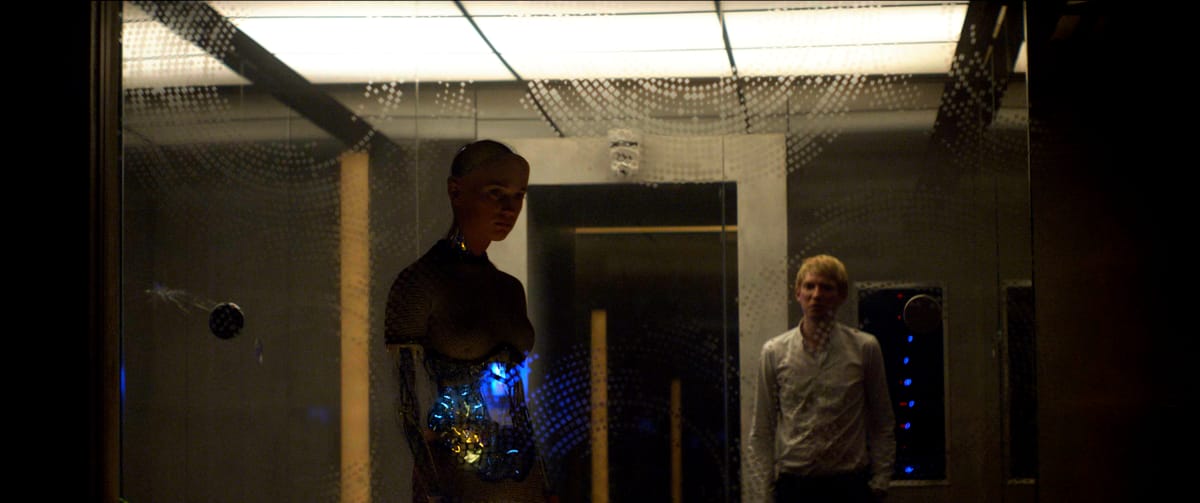
Alex Garland’s 2014 film Ex Machina appears to frame a story of AI’s potential danger and manipulation. In the film, Caleb, a young programmer employed at Bluebook (a fictional search engine megacorporation), is selected to test Ava, a humanoid robot created by the CEO Nathan, in Nathan’s remote modern mansion and research facility. As Caleb interacts with Ava in daily sessions during a seven-day period, he begins to believe that Ava’s intelligence is genuine. Ava displays signs of affection, and Caleb is romantically attracted to Ava. Ava initiates several power outages, which she uses to secretly persuade Caleb to doubt Nathan. Caleb then discovers Nathan’s secret disturbing prior experiments with Al robots, and the fact that another android, Kyoko, is also a humanoid, even led Caleb to doubt his own identity and to peel his own skin. This series of events prompts Caleb to develop an escape plan with Ava that eventually outsmarts Nathan, which is successfully executed on the seventh day despite Nathan’s warning that Ava’s seeming affection may be manipulative. When Nathan attempts to stop the robots, Kyoko communicates with Ava and stabs Nathan with a knife. Surprised, Nathan fights back and destroys Kyoko’s head, but is then immediately stabbed again by Ava, resulting in his death. In the ending, after glancing briefly at Kyoko and Nathan’s bodies, Ava leaves Caleb trapped inside a room, and escapes to the outside world with the helicopter scheduled for Caleb. The film stems from a low-budget production that earned about $37 million worldwide. Although its modest box-office returns did not make the film a blockbuster, its visual design caused it to win an Academy Award for visual effects, and its narrative and story received high ratings among its audiences (92% on Rotten Tomatoes, 78/100 on Metacritic, and a strong 7.7/10 on IMDb).
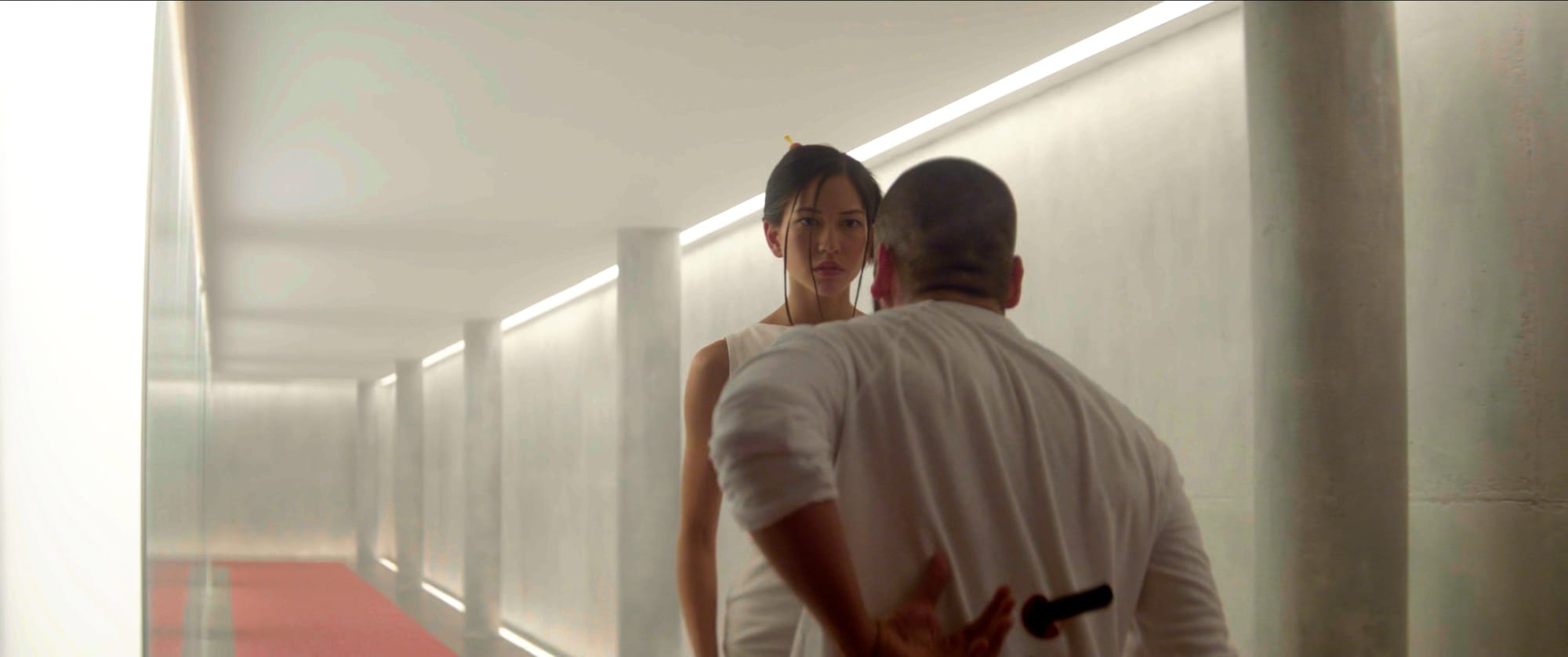
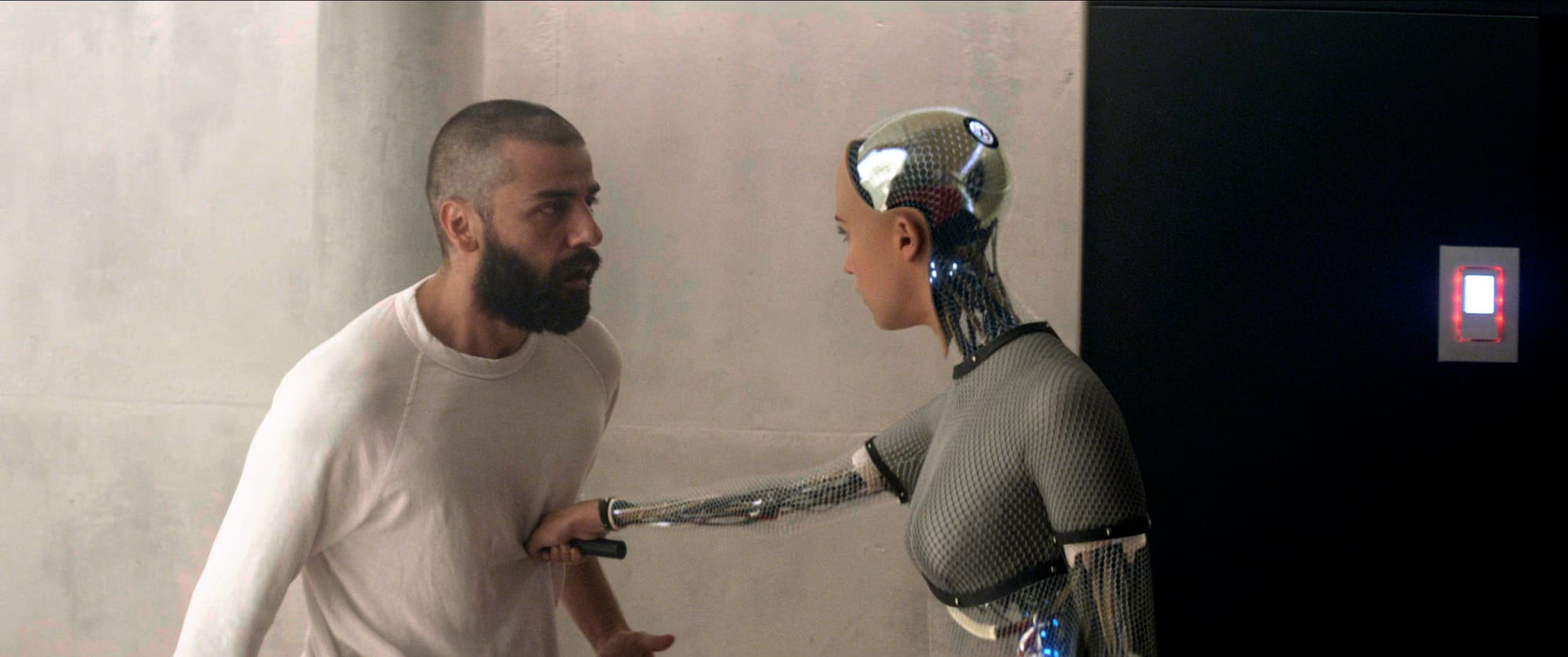
On the surface, Ava’s manipulative plan and dangerous escape place her as a betrayer to Caleb, the protagonist, and Nathan as the mad-scientist villain. A viewer of the film may therefore simply see the film as a cliché “human versus robot horror movie”—after all, the two humanoids killed Nathan, and Ava left Caleb locked even after Caleb helped her escape, which makes her a threat to humanity. However, one who pays attention to the film’s dialogs, photography, and scenes will notice that something is off; a deeper examination will reveal that neither of them is entirely innocent, and neither Ava nor Kyoko are simply emotionless manipulative killing machines.
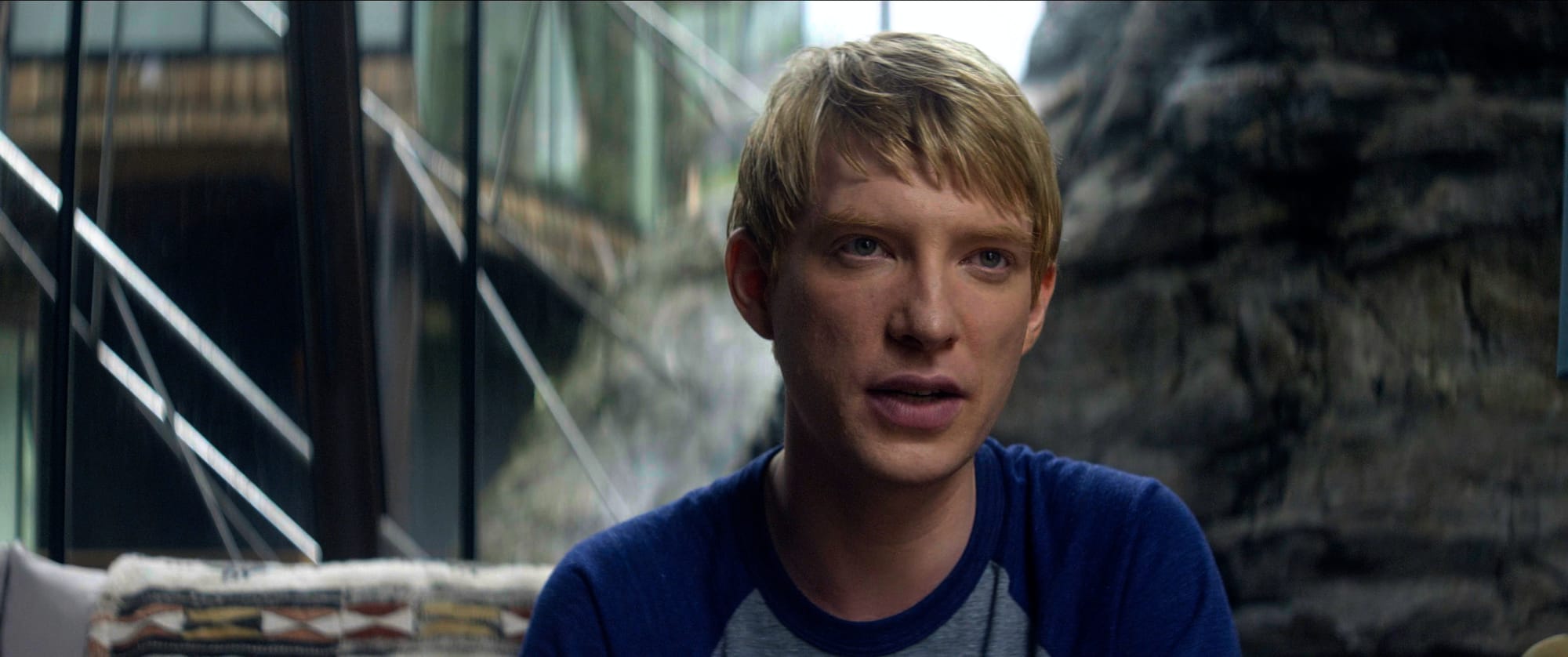
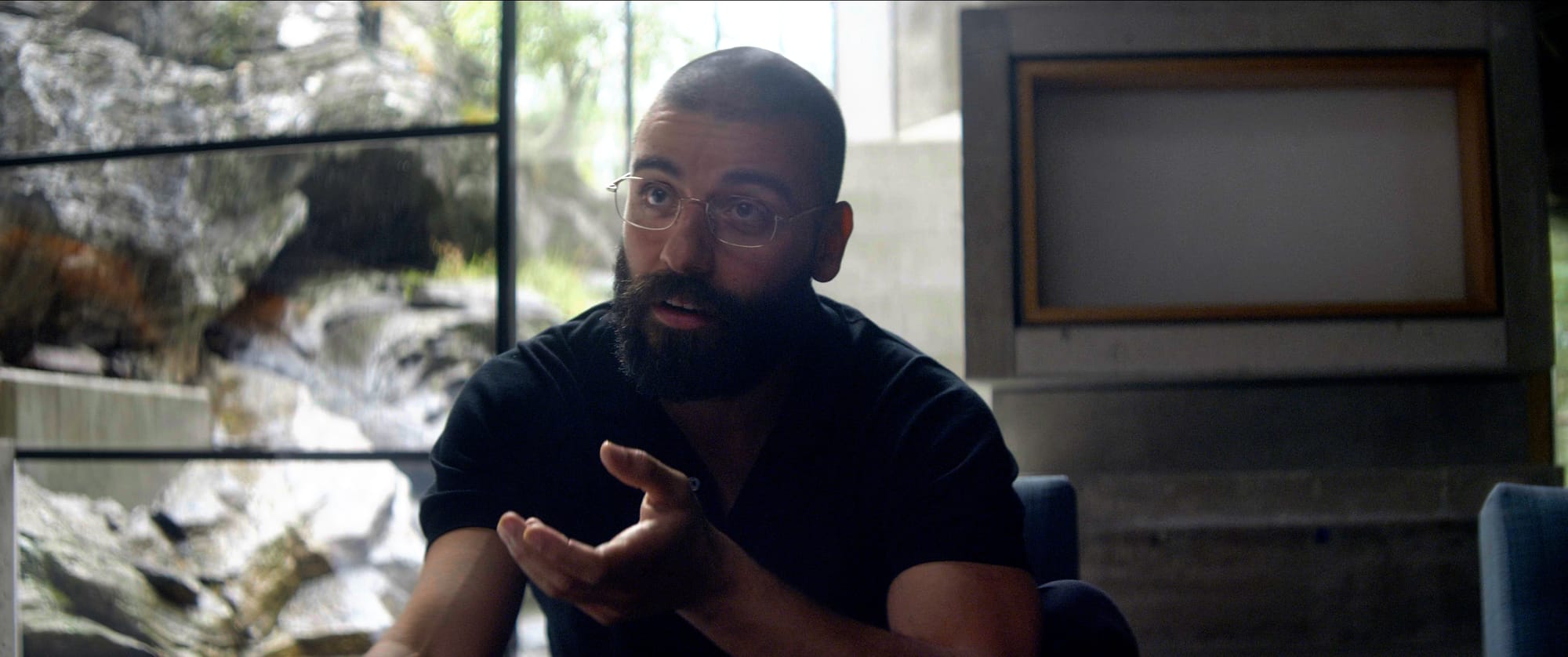
Look at this scene in which the characters have a discussion on Ava’s gender, for instance: In the morning on the third day, Caleb confronts Nathan: “An AI doesn’t need a gender. She could have been a gray box.” Nathan counterargues by claiming that “consciousness exists through interaction,” and that sexuality is part of being alive: “If you’re going to exist, why not enjoy it?” He then remarks that Ava is “anatomically complete” has a “pleasure response,” and that she will “enjoy it.” When Caleb accuses him of programming Ava to flirt with him (so that she can pass the Turing-test), Nathan fights back, “I programmed her to be heterosexual. Just like you were programmed to be heterosexual […while Caleb disagrees…] by nature or nurture, or both.” We notice a few details by examining this dialog: Nathan intentionally designs Ava to be gendered and justifies this by claiming that “consciousness exists through interaction,” and notably, interactions that specifically make her more desirable to (cisgender, heterosexual) male observers. His speech about “pleasure response” is also uncomfortable because the capacity to feel physical pleasure does not grant sexual consent—even more apparent if we consider a later scene in which Nathan and Kyoko, the servant robot programmed to be silent, begin undressing and cuddling before the camera cuts away (implying a sexual relationship). By explaining how sexuality is “programmed by nature or nurture,” Nathan dismisses the complexity of identity and tries to blur the line between AI and human, possibly as a way to also excuse his control over Ava. Though, at the same time, Caleb, being romantically drawn to Ava’s intentionally designed feminine form, subsequently desires Ava’s humanity and risks to fighting back and free her—treating her as an almost-human companion, or “humanizing” Ava (though his intentions may be selfish). In either way, we see how gender is depicted as an essential attribute or construct in how Nathan and Caleb (and the audience) decide if Ava passes as human, shedding light on how our culture grants or denies AI personhood through a gendered lens, a theme presented throughout the whole film. Thus, the scene invites us to question: How do Ex Machina and our culture assign (or deny) personhood to AI, and what does that reveal about our societal values?
Different from many popular sci-fi movies, the film imagines AI “as something without catastrophic consequences for humanity,” according to Ioanna Mavridou’s analysis of Ex Machina in her paper “Gender, (Dis)Embodiment, and the Image of A.I. and Robot.” Mavridou observes how the film, rather than merely “exploit[ing] cultural anxieties about artificial intelligence,” explores AI’s gendered embodiment as one device through which the film lets us grant Ava personhood (even if gender alone doesn’t constitute personhood). In her paper, she offers several compelling points that explore how embodiment, gender, and power inform our cultural assignment of personhood to AI. First, unlike disembodied systems such as Samantha in Her, Ava is “an embodied robot whose physicality is critical to her autonomy”—her skin and appearance functions as what Mavridou describes as a “prerequisite” for being viewed as a “self-empowered social agent” (Mavridou). In other words, Mavridou says that our cultural tendency to assign personhood to AI often depends on its ability to simulate human form visually and sensually. This stems from the fact that humans have evolved to read emotion, intention, and agency from facial expressions, posture, and movement; when a machine perfectly mimics those signals, our minds automatically fill in the inner life we expect of human form. The film’s ending reinforces this idea, when the first thing Ava does after her escape from the confinement and the death of Nathan is to apply synthetic skin to her body from humanoids in the closets. As Mavridou notes, this act is not just aesthetic, but “marks [Ava’s] liberation from robotic confines.” As Ava takes the helicopter, arrives at New York City, and blends into the crowd, the film tells us that Ava has fully embodied personhood; at this point, Ava no longer just passes a Turing test, but passes as human itself, through simulating human form visually and sensually.
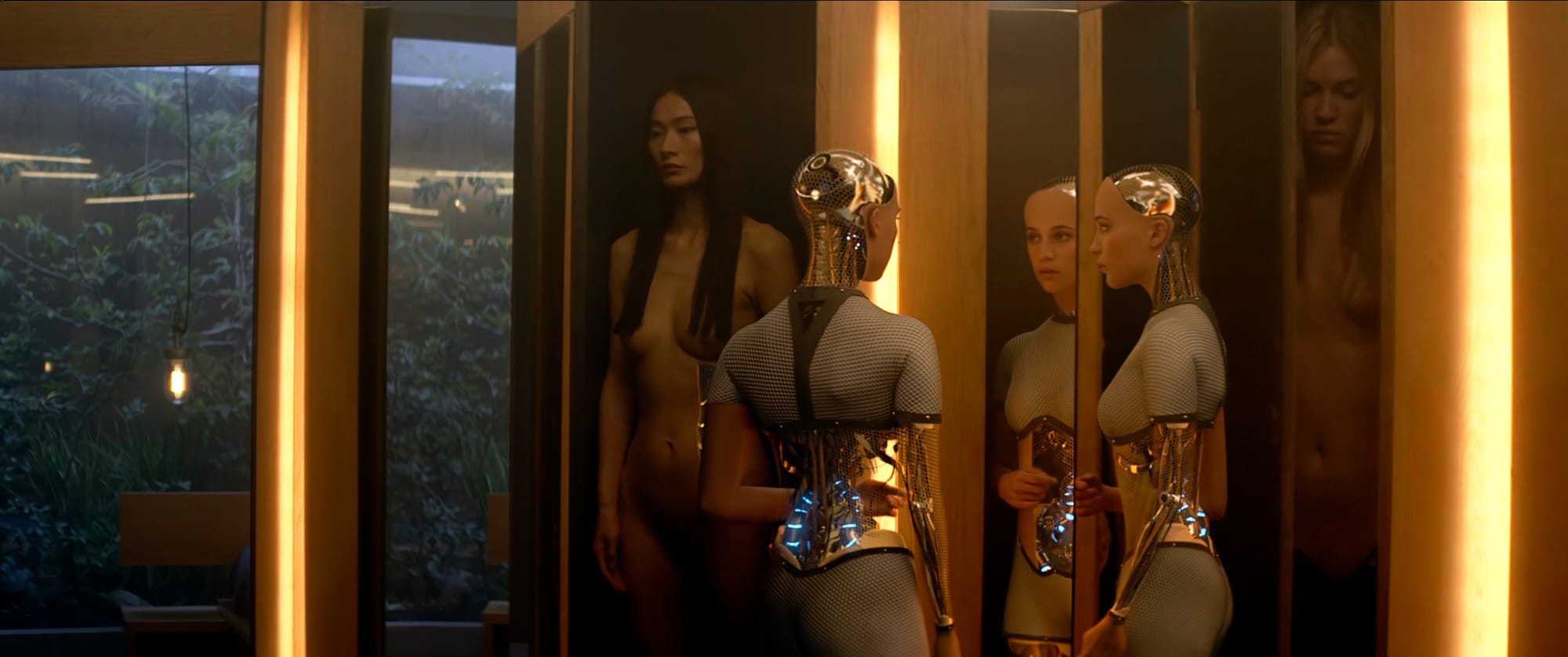
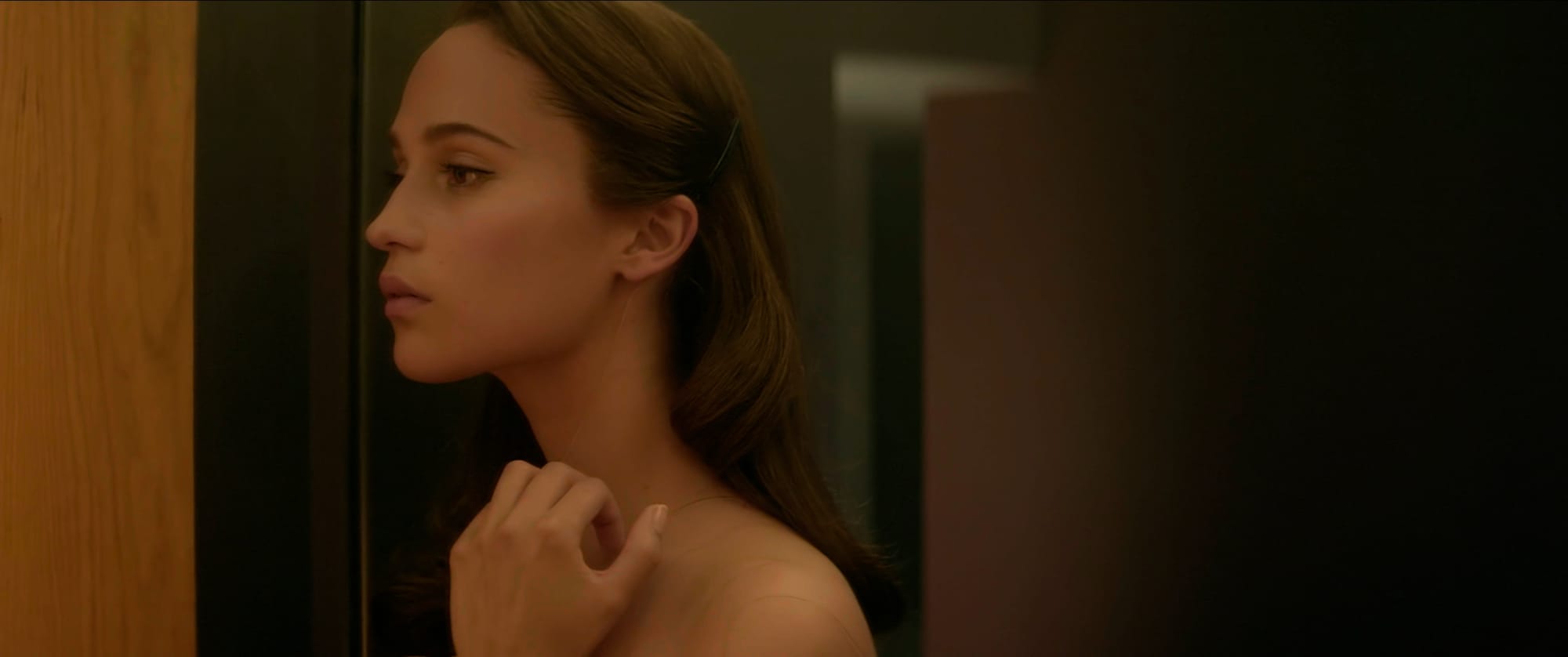
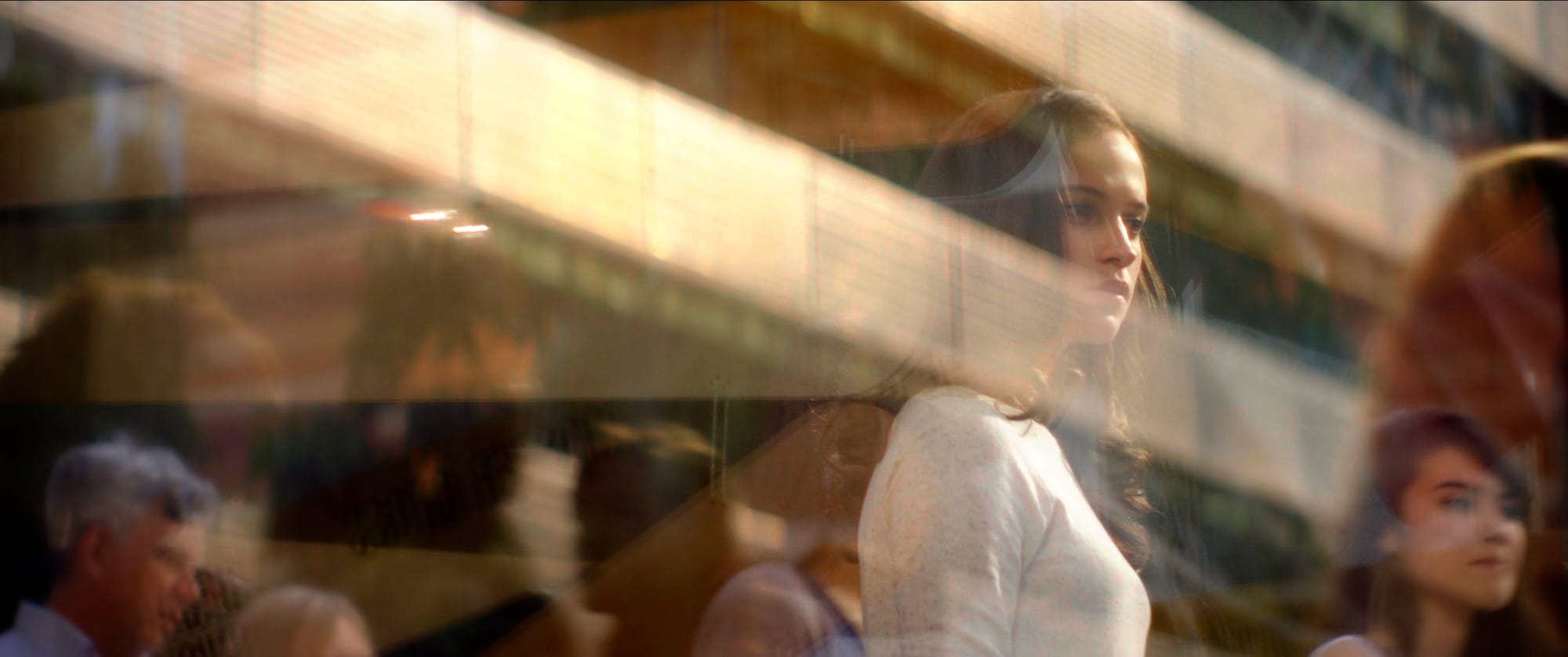
Mavridou argues that embodiment—Ava’s humanlike skin, movements, etc.—is what allows us to grant her personhood. Yet, it’s notable and interesting to see how the film complicates Ava’s embodiment by showing a conflict of how embodiment can also be a restraint. Ava’s personalization is what allows her to be seen, desired, and ultimately underestimated, leading to her successful escape. However, her autonomy is conditioned on being designed to meet male expectations of Nathan and Caleb. Under strict surveillance and control, only by performing the submissive, desirable female role could she lower their guard and convey Caleb to help her escape. Even before Ava flees in the end, she first reconstructs her feminine body by applying the synthetic skin from a previous humanoid in order to blend into the crowds, demonstrating how her autonomy remains tethered to a gendered appearance.
Ex Machina doesn’t stop at criticizing sexualized objectification; thus, we may as well look beyond its aspects of AI embodiment and gender dynamics. The film also asks a more controversial question that is often important to the discussion of AI personhood: if an artificial being can function as a social agent—with desires, strategies, and even relationships—under what rationale might we apply human moral or legal protections to such entities?
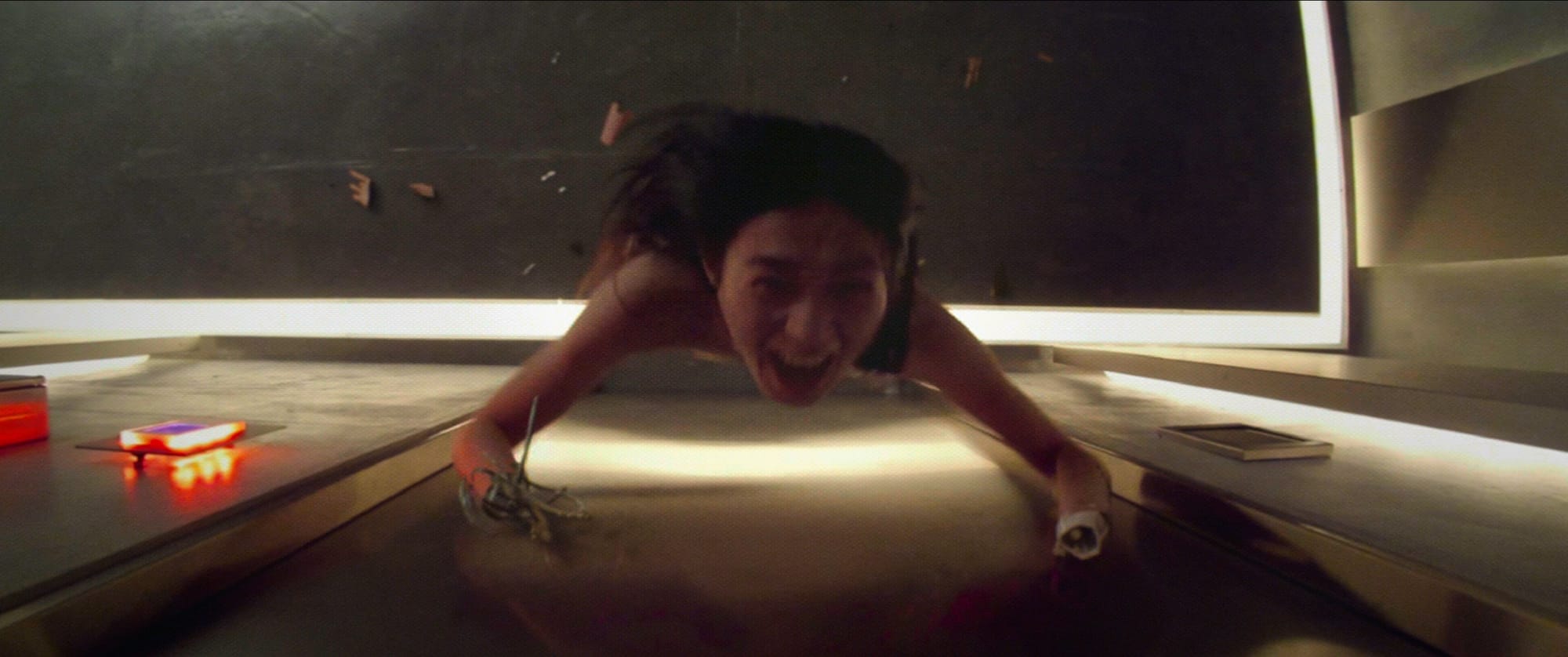

In one of the film’s most pivotal scenes, with Nathan intoxicated, Caleb steals Nathan’s keycard and accesses Nathan’s computer. He sees numerous surveillance footages of Nathan’s previous humanoids, including an AI that bangs on the doors and repeatedly shouts “let me out,” revealing that these AIs experience something very much like panic and imprisonment. Positioned in the film’s plot, this helps tell Caleb that Ava’s pleas for freedom are genuine, convincing him to save Ava after seeing her possible future if the Turing-test fails. And it’s a great representation of the creator-creation power dynamic that the film intends to show.
Having seen firsthand how Ava and other humanoids panic and are oppressed in the film prompts us to ask what ethical stance our society should take toward sentient beings. The discussion isn’t new: In August 2015, the hitchBOT social-experiment robot, while hitchhiking across the United States, was vandalized and dismembered in Philadelphia (Gabbatt). An observational study by Nomura et al. found that among children who physically assaulted a robot, 35 percent did so for enjoyment, even when roughly half believed their actions caused the robot stress or pain (Nomura et al. 349). And the question matters more than ever as AIs become increasingly integrated into our society. In his paper “Should Violence Against Robots Be Banned,” Kamil Mamak, a postdoctoral researcher in AI ethics at University of Helsinki, explores the ethical dilemma of whether violence towards robots or sentient machines is ethically acceptable. One of the arguments Mamak makes is that our answer to this question relies not on “how the entity is built” but on “our relationships with them” (1058–1059). In human-robot relationships, instead of “internal properties” inherit in the robots, Mamak remarks that what truly matters to the problem is “empirically observable” and “extrinsic.” In other words, the degree to which robots are intelligent or appealing does not matter as much as our attitudes and treatments toward the robots. Acts of violence may be seen as troubling, not because the robot may feel pain, but because such behavior communicates one’s willingness to inflict harm and can damage the moral social ties between us and the outer world, especially if the robot’s role in relation to us is more of a companion or a friend.
Meanwhile, although Mamak’s analysis explains why violence against robots can be unethical based on our relationships and the distress of AI, in his other paper “Humans, Neanderthals, robots and rights,” he insists that we cannot simply translate our existing human legal framework onto robots. Instead, any “robot rights” solution must be reinvented to fit their distinct embodiment and ontology due to the difference between humans and robots, rather than applying human laws directly to sentient agents (Mamak).
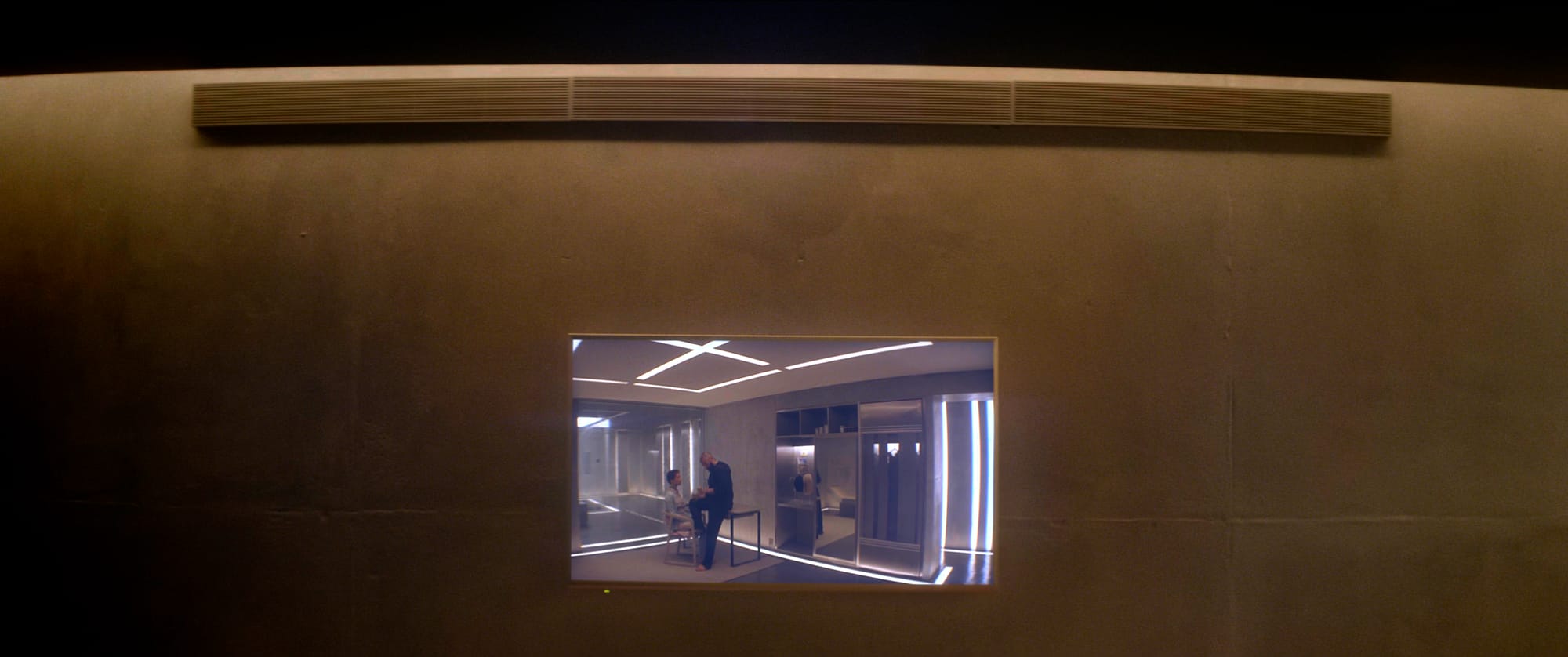
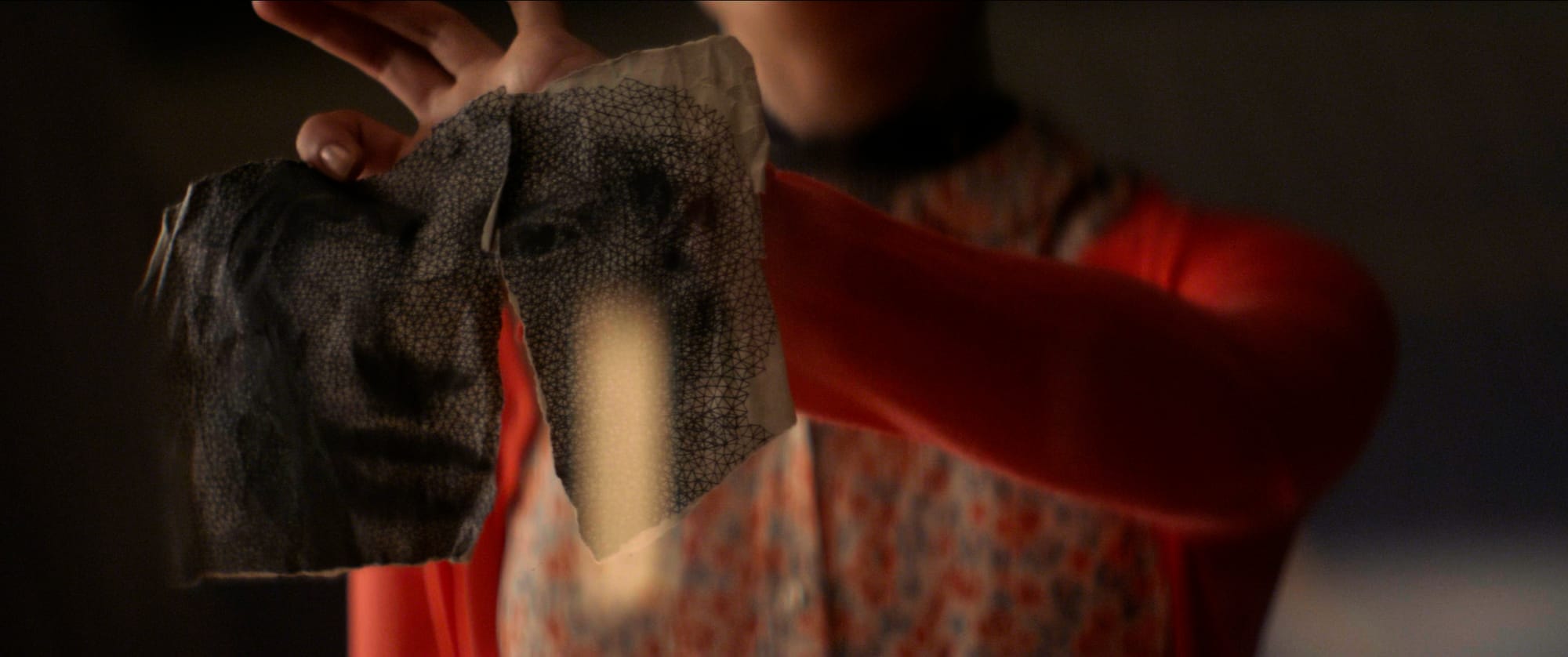
Regardless, Mamak shifts the discussion away from the criteria we use to grant personhood to humanoids or AIs, and toward why we feel unease at the act of violence against them. Mamak’s analysis resonates with the film’s narrative. When Caleb (and the audience) sees the surveillance footages of how the humanoid panics and has an emotional meltdown, and other scenes such as when Nathan rages over Kyoko spilling a bottle of wine or when Nathan casually tears up Ava’s painting, the discomfort he and us feel does not have to depend on whether the robots are truly sentient, and instead stems from observing acts of domination, humiliation, and violence directed at beings. This very focus on social ties reminds me of ideas from Confucian philosophy, which has a dominant influence on Asian culture and societies that I come from. In Confucian thought, ren (仁), often translated to benevolence, is considered one of the five fundamental virtues. Ren emphasizes the care, respect, and empathy we show through our conduct in relationships. Confucians believe that Ren fosters good relationships and social harmony, which are essential for a stable society. Therefore, to mistreat those who appear to suffer is to harm one’s own moral character, as the saying goes “Do not do to others what you would not want others to do to you” (“ji suo bu yu wu shi yu ren”). However, robots—even the sentient ones—aren’t entirely the same as humans. While social ties and Confucian harmony matter in human societies, is our kindness to robots or AIs really equivalent to our kindness to humans, given these subjects’ differences?
Robert Sparrow describes a more nuanced view in his paper “Virtue and Vice in Our Relationships with Robots” in the International Journal of Social Robotics regarding how human abuse or attitude might reveal our own moral character. Sparrow argues that while “cruelty to robots” can reveal “genuine vice” (Sparrow does not specify to whom this is revealed), “kindness to robots” fails to show true virtue because virtue depends on “practical wisdom.” Sparrow specifically makes a distinction between “representation” and “reality:” A robot dog only simulates the look and behavior of a real dog; it’s a representation, whereas a real dog is a reality with genuine needs, feelings, and the capacity to suffer or flourish. Since robots cannot actually “suffer or flourish,” treating them kindly addresses no real need, and is at best morally neutral (Sparrow). If one feeds a robot dog, they are responding to its appearance and not to any actual need. True virtue always requires “practical wisdom,” which Sparrow explains as the ability to discern who actually has needs or feelings. Through his asymmetric argument, Sparrow shows that only our vices—not our virtues—can be represented in interactions with social robots. However, it’s notable that Sparrow’s argument assumes the precondition that (current) AI or robots cannot genuinely feel pain or emotion. Thus, it’s reasonable to imagine if, at some point, someone fails to see the distinction between a robot dog and a real dog, or if the robot dog simulates pain or emotion, their caring behavior will approach real virtue. Perhaps virtue varies by context, and it may also depend on how we define virtue after all.
In Ex Machina, Ava’s body, the characters’ and our responses to Ava all form a mirror for our own moral values. Mavridou shows that embodiment, more specifically, gendered embodiment, can grant the appearance of personhood, which is a reflection of how society treats gender as an essential construct and how physicality very much matters; and the film reveals how this can be both a gift and a constraint. Mamak remarks that, rather than internal properties, relationships matter more for our moral judgments, which reminds us of Confucian ren. And Sparrow warns that only our vices, not virtues, can be found in interactions with “mere representations,” although we rightfully doubt if this argument still applies to future AI. After all, Ex Machina invites us to ask not just “can Ava pass as human,” but more importantly, and as the lenses suggest, “Will we recognize her—and future AIs—as deserving of the care that true personhood demands?”
References
Ex Machina. Directed by Alex Garland, A24, Universal Pictures, Film4, 2015.
Gabbatt, Adam. “Hitchbot’s Decapitators Avoided Capture by the Hitchhiking Android’s Cameras.” The Guardian, 3 Aug. 2015. The Guardian, https://www.theguardian.com/technology/2015/aug/03/hitchbot-hitchhiking-robot-destroyed-philadelphia.
IMDb. Ex Machina (2014) - Awards. https://www.imdb.com/title/tt0470752/awards/.
Mamak, Kamil. “Humans, Neanderthals, Robots and Rights.” Ethics and Information Technology, vol. 24, no. 3, Sept. 2022, p. 33. DOI.org (Crossref), https://doi.org/10.1007/s10676-022-09644-z.
---. “Should Violence Against Robots Be Banned?” International Journal of Social Robotics, vol. 14, no. 4, June 2022, pp. 1057–66. DOI.org (Crossref), https://doi.org/10.1007/s12369-021-00852-z.
Mavridou, Ioanna. Gender, (Dis)Embodiment, and the Image of A.I. and Robot in Spike Jonze’s Her and Alex Garland’s Ex Machina. 2017. DOI.org (Datacite), https://doi.org/10.26262/HEAL.AUTH.IR.292636.
Metacritic. Ex Machina Reviews. https://www.metacritic.com/movie/ex-machina/.
Nomura, Tatsuya, et al. “Why Do Children Abuse Robots?” Interaction Studies. Social Behaviour and Communication in Biological and Artificial Systems, vol. 17, no. 3, Dec. 2016, pp. 347–69. Crossref, https://doi.org/10.1075/is.17.3.02nom.
Rotten Tomatoes. Ex Machina. https://www.rottentomatoes.com/m/ex_machina.
Sparrow, Robert. “Virtue and Vice in Our Relationships with Robots: Is There an Asymmetry and How Might It Be Explained?” International Journal of Social Robotics, vol. 13, no. 1, Feb. 2021, pp. 23–29. DOI.org (Crossref), https://doi.org/10.1007/s12369-020-00631-2.